
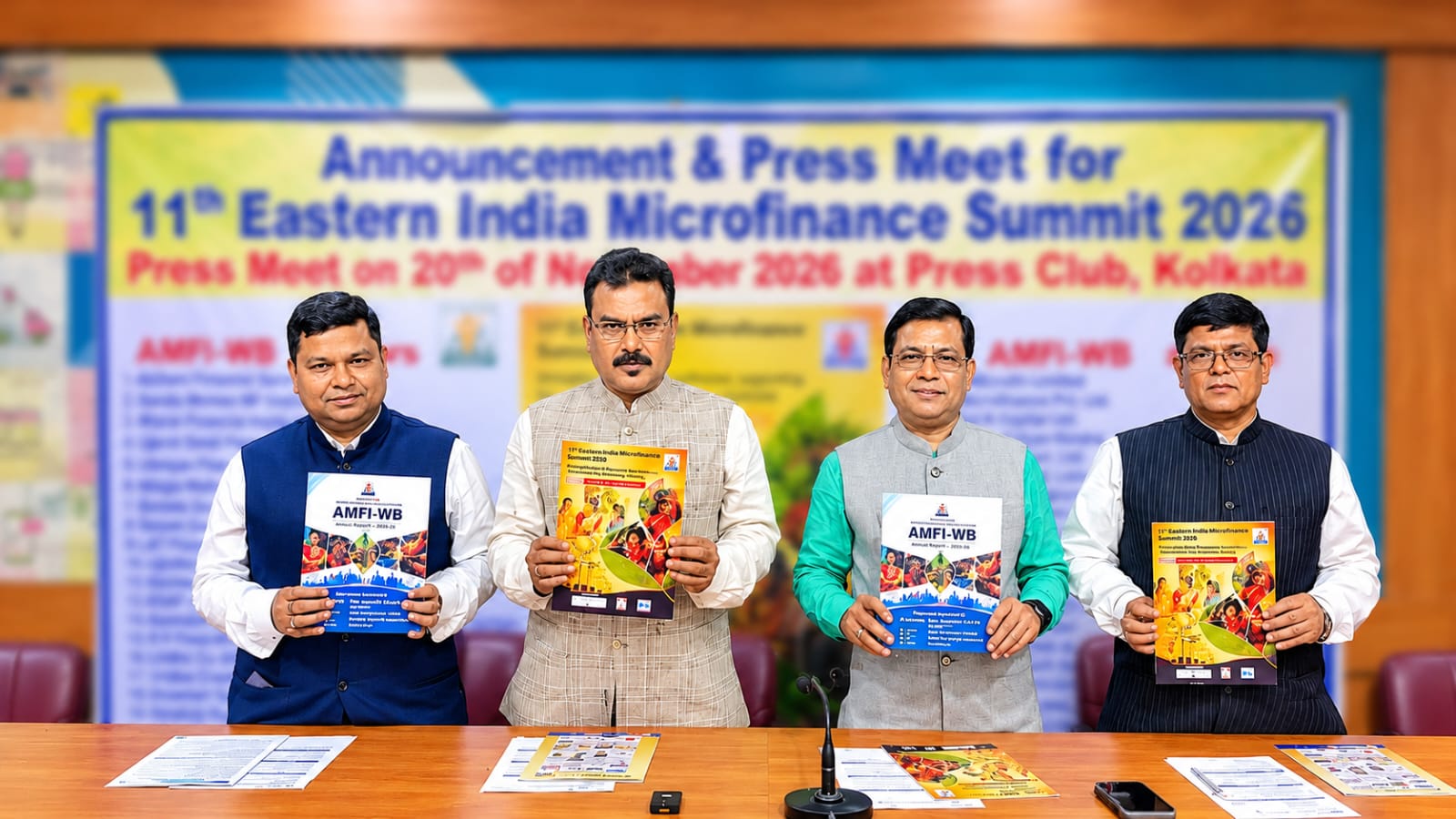
Staff Reporter : Kolkata, 26th November, 2026: The Association of Microfinance Institutions – West Bengal (AMFI WB) announced at a press conference held at the Kolkata Press Club that it will organise the 11th Edition of Eastern India Microfinance Summit 2026 in association with MFIN and Sa-Dhan, and supported by Equifax as Knowledge Partner; M2i as Research Partner and Arohan Financial Services Ltd as Conference Partner. The Summit will be held on 4th of December 2026 at Biswa Bangla Convention Centre, New Town, Kolkata.
The theme of this year’s summit “From Aspiration to Advancement: Reimagining Microfinance’s Role in India’s Growth Story” reflects the industries own evolution alongside the country it serves, particularly in the Eastern India. It is built on three ideas:
Changing Aspirations of the new India: As India’s borrowers, particularly in the Eastern regions, move beyond basic access towards advancement with larger livelihoods, diversified income and greater financial choice, microfinance must reimagine its products, delivery models and partnerships to keep pace with client ambition rather than lag behind it.
Reimagining, Not Just Responding: Rather than reacting defensively to disruption, the sector has an opportunity to proactively redesign itself: diversifying products and funding sources, embracing technology and data responsibly and rethinking who it serves and how.
A Deliberate Participant in India’s Growth Story: Microfinance’s contribution to Viksit Bharat cannot be assumed as automatic. The sector must actively position itself to government, regulators and investors as a driver of inclusive growth.
The 11th Eastern India Microfinance Summit 2026 will bring together MFIs, Banks, Fintechs, Investors, Regulators and Civil Society to discuss and deliberate how the sector reimagines itself for this next chapter, one where growth is measured not only by outreach, but by how meaningfully it advances the aspirations of the households it serves.
Session 1: Beyond the Numbers: Emerging Challenges and Opportunities in Eastern India’s Microfinance Landscape.
Session Overview: Eastern India is home to one of the largest concentrations of microfinance borrowers anywhere in the country which represents a market of enormous scale and untapped potential. As national conversations on microfinance often default to an all-India lens, this session offers a closer look at what makes the East distinctive. This session moves beyond aggregate national issues to spotlight the opportunities the region’s scale represents, the innovations already emerging from within it and the collaborative steps that can help the East realize its full potential as a growth engine for the sector as well as the country.
Key Discussion Points:
• What makes Eastern India’s borrower base and MFI ecosystem distinctive, and how can this scale be leveraged as strength for the sector?
• What emerging opportunities exist for MFIs operating in West Bengal and the wider East to deepen outreach responsibly?
• What region-specific challenges set Eastern India apart from the rest of the country’s microfinance landscape?
• How can policymakers, regulators, and investors partner more closely with the region to unlock its full potential?
• What can the rest of the country’s microfinance sector learn from Eastern India’s experience and ground-level practices?
Session 2: One Size Doesn’t Fit All: Diversifying Access Across MFI Sizes and Customer Segments.
Session Overview: Microfinance was built on the promise of reaching those excluded from mainstream finance. Yet as the sector matures, a new form of exclusion has quietly emerged. As institutions grow in scale and shift towards larger ticket sizes and more secured lending, segments of the population that were once well-served, particularly those seeking smaller loans and new-to-credit borrowers, risk being left behind. At the same time, small and mid-sized MFIs, which have historically been closest to these underserved segments, face their own constraints around capital access, institutional support and regulatory guardrails that do not always account for their differentiated context. This session examines how the sector can build more differentiated, deliberately inclusive approaches to access, ensuring that diversification and growth serves all the stakeholders.
Key Discussion Points:
• As MFIs diversify into secured and higher-ticket lending, how can the sector ensure smaller-ticket and new-to-credit borrowers continue to be well served?
• Is expanding access to underserved and excluded segments the responsibility of small and mid sized MFIs alone or should larger institutions and banks play a greater role?
• How can regulatory guardrails be designed with greater flexibility to reflect the differentiated realities of institutions across sizes and the diverse customer segments they serve?
• What capital, funding, and institutional support do small and mid-sized MFIs need to remain viable and continue serving their core segments?
Session 3: Serving Aspirations Responsibly: Technology, New Business Models and Innovative Products for Borrowers.
Session Overview: As borrower aspirations move beyond basic credit access towards genuine economic advancement, the microfinance sector has a powerful opportunity. It can strive to serve these evolving needs while placing responsibility and borrower protection at the very heart of that growth. Technology, new business models and innovative product design offer powerful tools to deepen reach, improve credit assessment and expand the range of services available to low-income households. If these tools are deployed thoughtfully, these can strengthen safeguards, deepen trust and ensure innovation translates into genuine borrower well-being rather than mere access. This session explores how the sector can harness innovation deliberately and responsibly ensuring that as products, delivery models and technology evolve, the borrower’s interest remains central to that evolution.
Key Discussion Points:
• How can technology and data-driven tools improve credit assessment and delivery while preserving the field-level judgment and household context that responsible lending requires?
• What new business models, beyond traditional group lending, can help MFIs serve borrowers’ evolving needs more effectively and sustainably?
• Beyond credit, what innovative products (savings, insurance, livelihood-linked offerings) can help borrowers build genuine resilience and advancement.
• What safeguards are needed to ensure that innovation in products and technology does not come at the cost of borrower protection?
• How can the sector balance the pace of innovation with the need to build borrower trust and long term financial well-being?
There will be around 400 delegates in the summit with the following categories: MFIs (NGOs as well NBFCs, SFBs, BCs and Bank) who are operating in West Bengal, Odisha, Jharkhand, Bihar and North Eastern States. Expected over 60 MFIs from Eastern India; Delegates from neighboring countries; Banks, Regulators, Ratings Agencies; Fintech, IT, Software Companies; Insurance Companies; Researchers, Scholars and Students; Energy Companies especially green energy providers and social enterprises; Mobile Banking/Core Banking Solution Providers; Industry association/network; Donor agencies/multilateral Institutions and International Agencies; Consultancy firm.
The Association of Micro Finance Institutions – West Bengal (AMFI – WB): AMFI WB is one of the oldest microfinance associations in India, established in 2006 and registered as a public trust in 2010, with a dedicated focus on West Bengal, one of the biggest microfinance markets in the country. The Association serves as a unified platform for community Microfinance Institutions operating in the state. Membership in AMFI-WB provides organizations with the credibility of being associated with a recognized Self-regulatory industry body committed to promoting responsible finance, strengthening governance and building a stronger microfinance ecosystem. The association has primary (lenders who write loans on their own balance sheet), secondary (those who facilitate business on others books), associates (entities associated with microfinance activities) and special members (members of high esteem & repute), creating a diverse and collaborative ecosystem for the industry. https://amfi wb.org/









Be First to Comment